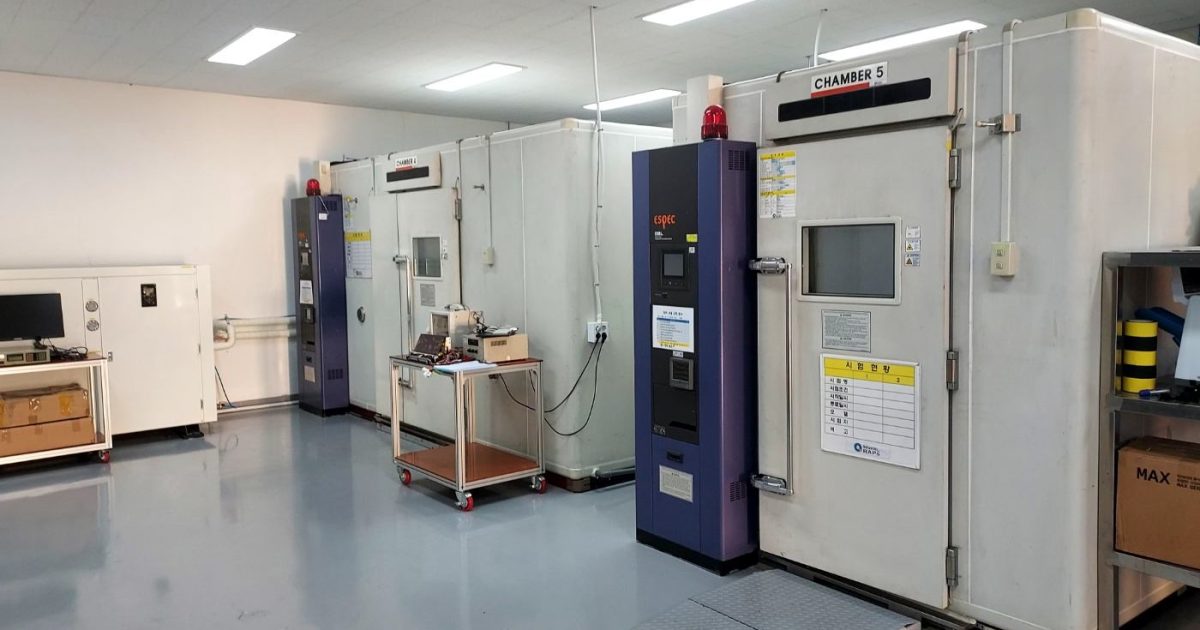
Accelerated life testing (ALT) designs and applies conditions harsher than real use so that a product's service life can be predicted in a short period. The aim is to bring out, within the test period, failures that would take a long time to appear in real use.
Designed from the product, not taken from a standard
We do not simply take test conditions from a standard. We analyse the product's operating environment and failure mechanisms and design the acceleration conditions for each product. The work runs in this order: operating environment analysis → acceleration condition design → accelerated testing → weak point extraction. Conditions of use are analysed at the design stage to draw out problems, and accelerated testing then confirms and closes the weak points.
Four stages of test design
| Stage | What we do |
|---|---|
| 1. Architecture & Failure Mode | Define the product structure and expected failure modes |
| 2. Potential Failure Mechanism | Derive the mechanisms that could cause failure |
| 3. Dominant Failure Mechanism | Select the dominant failure mechanism and determine the acceleration factors (temperature, humidity, voltage, vibration and others) |
| 4. Acceleration Test | Run the test under the acceleration conditions, predict life and extract weak points |
Results go back into design
When testing is complete, we predict the limit life from the results and present the cause analysis for weak areas together with proposed design improvements. The aim is for the test data to be fed back into the next design.
Which products do we test?
- Automotive electronics (sensors, controllers, modules), power supplies, LED modules, motors and actuators
- Appliances and IT devices, healthcare IoT terminals
- Industrial robots and controllers, system products such as screen golf
Research and project record
| When | What |
|---|---|
| Nov 2010 | LG — accelerated life testing of OEM LCD monitors and test equipment fabrication |
| Jul 2015 | Joint Chiefs of Staff — life prediction and accelerated life testing of military equipment |
| Dec 2022 | Hyundai Rotem — accelerated life testing of K2 tank control units (obstacle clearing) |
| 2023 | Defence paper — accelerated life evaluation of K2 tank electronics (co-authored with Hyundai Rotem) |
| 2023 | Hyundai Mobis — accelerated life test methods developed and executed for the Silver Box and others |
| Jul 2023 | Hyundai Mobis — accelerated life testing of controllers |
| Apr 2024 | EVS37 (International Electric Vehicle Symposium) — paper published: The Study on Accelerated Life Testing of Electric and Electronic Systems for Electric Vehicles (co-authored with Hyundai Mobis) |
In February 2020 we registered a patent for a "life prediction system and method for electronic devices" (Patent No. 10-2081184). See the Accelerated Life Testing page for more.
Frequently asked questions
Q. How does accelerated life testing differ from environmental reliability testing?
Environmental reliability testing confirms that a product keeps its performance and structure under temperature, humidity, corrosion, vibration and shock conditions harsher than real use. Accelerated life testing designs and applies harsh conditions to predict service life in a short period. Environmental testing is covered on the Environmental Reliability Testing page.
Q. Can you test a product with no applicable standard?
Yes. For products without a defined standard we analyse the real operating environment and expected failure modes and design the test conditions and pass criteria with you. Developing reliability specifications for new products is one of our core services.
Q. How are the acceleration factors chosen?
After selecting the dominant failure mechanism from the product structure and failure modes, we determine the acceleration factors — such as temperature, humidity, voltage and vibration — to match that mechanism.
Q. How long does it take and how much does it cost?
It depends on the product, the test items, the number of samples and the test conditions. Tell us about your product and the tests you need through Contact Us or on +82-32-326-0213, and we will provide a quotation and an expected schedule during consultation.